


Think about a colleague you know who’s been noodling on the same idea for two years. The enthusiasm and curiosity and interest has remained there, as has the lack of actual execution.
This physician is very bright and fully capable, and they’re not exactly paralyzed out of fear. What’s actually stopping them is the sense that they’re contemplating a big irreversible move which will change the trajectory of their entire career. It’s hard to make a decision that big.
But the reality is that you don’t have to redesign or blow up your career before taking a first step.
Small, intentional experiments can produce enough data to propel you forward in the right direction. Thinking about career redesign in this way can become something that’s able to be subject to a test. Let’s look closer at how the right design of an experiment can maintain your clinical foundation while still creating options for expansion. We’ll go over a practical 90-day example template for running a career experiment, and go over what distinguishes a good experiment from a bad one.
First, we have to lay out the false dichotomy between having to choose between two extremes. You’re not limited to either: a) completely leaving your practice, or making a large decision such as pursuing an advanced degree, or starting a company, versus b) staying stagnant in the same professional location and with the same role.
When you have a lingering curiosity about something, whether that happens to be entrepreneurship, investing, AI, or something else, the challenge is how you take that interest and translate it into a manageable, actionable step without feeling that you need a complete upheaval of your career. This gap between your signal of persistent curiosity and your demand for a complete career path is where many physicians get stuck.
The Gravitational Pull That Keeps Physicians Still
Some of the reasons why physicians lean towards a strong and abrupt career change make sense. For one, as physicians we tend to want certainty before we take action. Our clinical training and clinical practice awards certainty and precision and advises us to reduce ambiguity and uncertainty. This mindset is great for keeping patients alive and healthy and minimizing errors, but ends up being artificially restrictive when it comes to career experimentation and redesign.
Additionally, the realities of what is the best fit for you often can’t be answered through introspection alone, but through hands-on application and experimentation.
Another reason is that medical training tends to be built around large structured decisions such as what specialty to train in, where to do your fellowship, what type of practice to join, etc. And so physicians become used to these large, structured commitments as opposed to smaller reversible trials. As mentioned previously, a physician’s sense of identity can also restrict experimentation as it tends to threaten what you’ve worked so hard to build. And lastly, physicians tend to over-inflate the cost of trying, assuming that it will require a formal title, credential, a large audience or following, significant capital, or reduced clinical work. In many cases, if your experiment is designed well enough it won’t require any of those.
What is a career experiment? It’s a time-bounded, risk-bounded, small action which has the intent of producing information that will help you guide your future direction.
The main purpose of the experiment isn’t immediately to generate income or prestige or certainty, but rather to generate a small amount of data and evidence. What you actually want to get back is some form of feedback indicating whether you like the type of work that you started doing, whether you find it valuable, and whether you want to become known for that type of work. In running the experiment, you’ll get a sense of whether it fits with your purpose and identity, and it will also inform you as to what other types of skills or experience or relationships you would need to add. You’ll get a sense of the true fit with your underlying central thesis. Ultimately, you’re seeking clarity and better signal, all of which will inform your next steps.
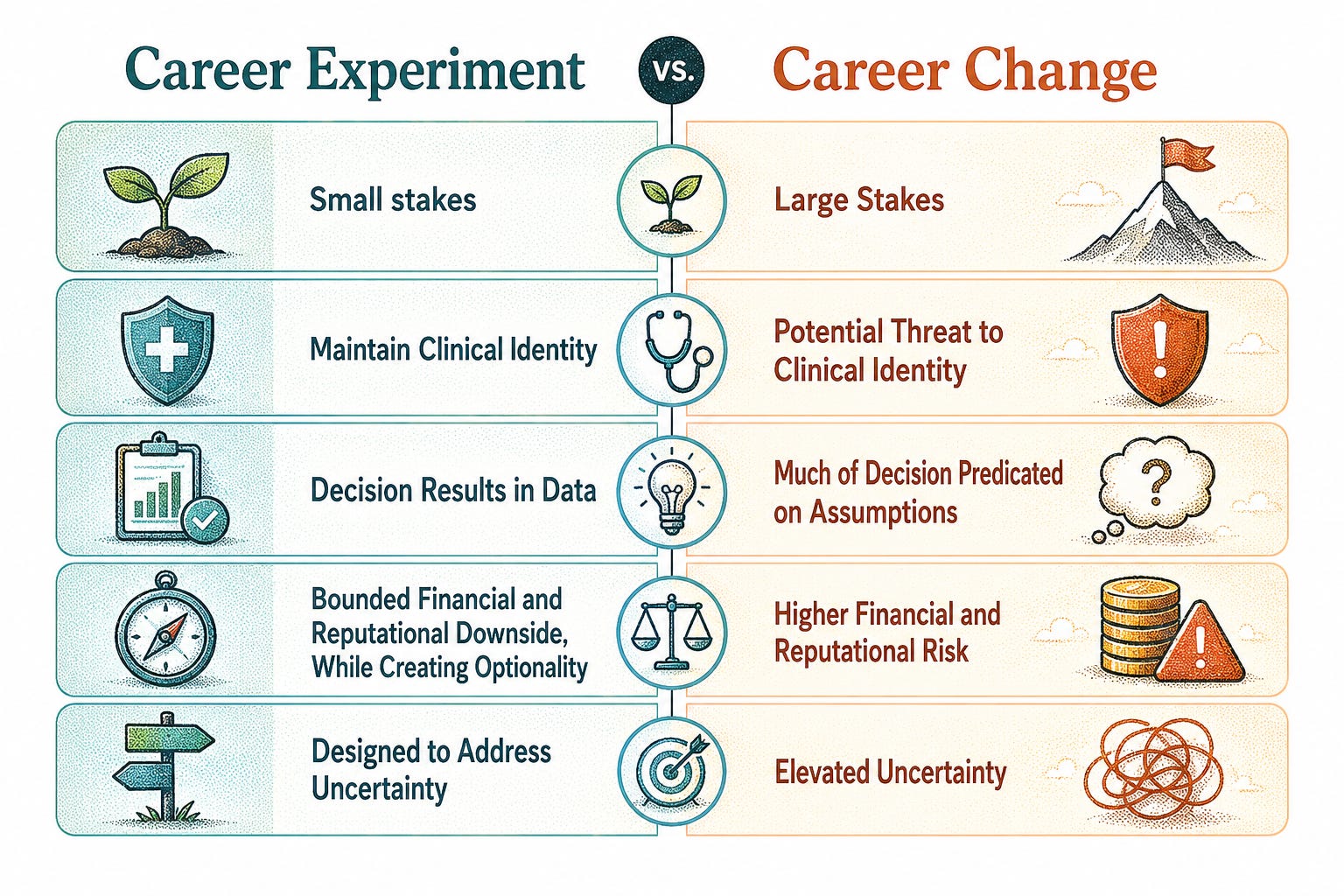
Instead of predicting the future, learn your way into it through a career experiment.
The Architecture of the Experiment
In terms of duration, the ideal career experiment is 90 days in length. This is long enough that you can get some genuine feedback and data and help you overcome the initial uncomfortable first few weeks. But it’s short enough that it triggers a reflection and review before forcing you to be part of a longer-term commitment that’s not the best fit. It doesn’t have to be 90 days, but this provides a clean demarcation point. Alternatives include one bounded project or deliverable, or one committee term.
The experiment should also be structured so that it has low downside risk. It will ideally have little to no financial downside, and it will minimally impact your personal and family obligations. Most likely it will have little to no impact on your professional reputation and clinical skill set.
It also needs to be specific and prompt action: for example, instead of saying “learn about startups” the concrete action would be “talk to four digital health founders”. It should generate evidence and you should be able to document that evidence so that you can refer to it and analyze it. Make note of how you were able to function in this experiment, the relationships that formed, and your sense of the strategic fit with the bigger picture of what you’re trying to do. Remember, try to align this with your central thesis instead of being a random activity that you’re adding on. And ideally it should provide you with the opportunity to build upon it when it comes to its end, if you should so choose. But also realize that if you stop, it doesn’t imply that the experiment failed, it just means that you learned what you don’t want to pursue.

Examples of Career Experiments
Leadership:
You could join a department or hospital committee, or an institutional working group or task force. You can volunteer to help build out a new service line or opportunity, or a new quality improvement project. You could serve as a mentor or create a mentorship program in your organization.
Advisory and Consulting:
You could reach out to three or four early stage startups that have some relevance to the field of medicine that you practice and ask if you could have a 20 to 30 minute conversation with one of the founders, with their CMO, or with their business development team. You could reach out to a healthcare company and see if there are any one-off consulting projects that they would be looking for a physician to partner with, which has a defined scope and end-point. You could offer to lend your perspective on a product they have in development and how it would fit within the clinical workflow. You could create a one-page document illustrating the strength and skills you have as a physician and how they might be applicable to industry.
Writing and Platform:
You can pick one topic that’s of importance to you and decide that you will write five mid-length articles on it and publish it on the social media platform of your choice. You can write a guest article on someone else’s newsletter three or four times over the coming weeks, or 2 guest posts on your specialty society’s website. You can offer to be a guest on two different podcasts and share your perspective on a topic you’re passionate about.
AI and Innovation:
You can offer to be a clinical champion for AI implementation at your institution, for the next quarter. You can take a free or paid healthcare AI literacy course or AI fundamentals course that spans 12 weeks. You can have four conversations with physician innovators that you connect with on LinkedIn to learn about their paths. You can volunteer to compare three different AI tools that address one workflow challenge in your practice, and report back to your group by the end of 12 weeks. You can interview four different AI implementation leaders over the course of the next 12 weeks.
Investing and Entrepreneurship:
You can read a book or take a short course to learn about the fundamentals of investing in early stage healthcare startups. You can have conversations with four or five physician angel investors, or venture capitalists with a healthcare background. You can join as a guest at two or three angel investor monthly meetings. You can review eight different pitch decks for healthcare startups. You can interview five different physicians about a clinical problem that you are thinking about building a solution around.
Teaching and Education:
You could develop one short training module for students or trainees. You could deliver two or three virtual guest lectures at different institutions or state specialty societies. You could create one educational resource or lecture for internal use in your department and track how it is received and utilized. You could create one live or virtual workshop where you talk about something you have expertise in and follow up to get feedback on how it was received.
Tangible Steps For Running the Career Experiment
Notice the Signal - What have you been persistently curious about? What has been frustrating you for a long time? And what are the things that provide energy, swings, or recurring interest?
Create a Hypothesis - Get specific about what you want to build or test.
Find the Smallest Possible Test - Resist the urge to have a grandiose project, but at the same time have a test large enough that will generate data, but small enough that you can complete it within 90 days.
Execute the Experiment - Put on your calendar a start date and an end date, the actual scope of the project, and what time blocks you will use to run the experiment.
Capture Return Signal - Write down data relating to how you were able to execute on the project, your energy level, the relationships formed, any inbound opportunities that came from it, and generally how you feel it aligned with your expectations.
Decide - Make a decision at the end of the 90 days as to whether you’re going to continue with more activity that is along the same lines as your experiment, and if so, how you will expand the scope or formalize it, or decide if you’re going to repeat the experiment again, or if you’re going to stop entirely.
Reinvest the Learning - Start a new experiment, but this time from a stronger baseline.
Failure Modes to Avoid
Make sure to avoid some of the common failure modes. One of these is making the experiment too large. The examples of this would be enrolling in a long or costly degree program, quitting your job and starting a company, or reducing your clinical work before you test the demand for the thing that you’re building. Make sure you’re only running one experiment at a time so that you can actually gauge process and outcomes. Make sure you prioritize learning over prestige and income; avoid the urge to tack on another side hustle for the sake of it or for the sake of income. Also remember that a title, while impressive, doesn’t necessarily produce forward momentum in the direction that you want to go. Also, manage your expectations regarding financial returns as you may not capture any income from this first experiment and the returns will accrue to you in the form of credibility, relationships, introductions, and knowledge.
Make sure to define an endpoint or at least a point in time in which you will check in with yourself and assess how the experiment aligned with your intentions. Lastly, remember that negative evidence doesn’t necessarily mean that there was a personal failure. There might have been an issue with your hypothesis, the scope of the project, the format, or any number of factors.
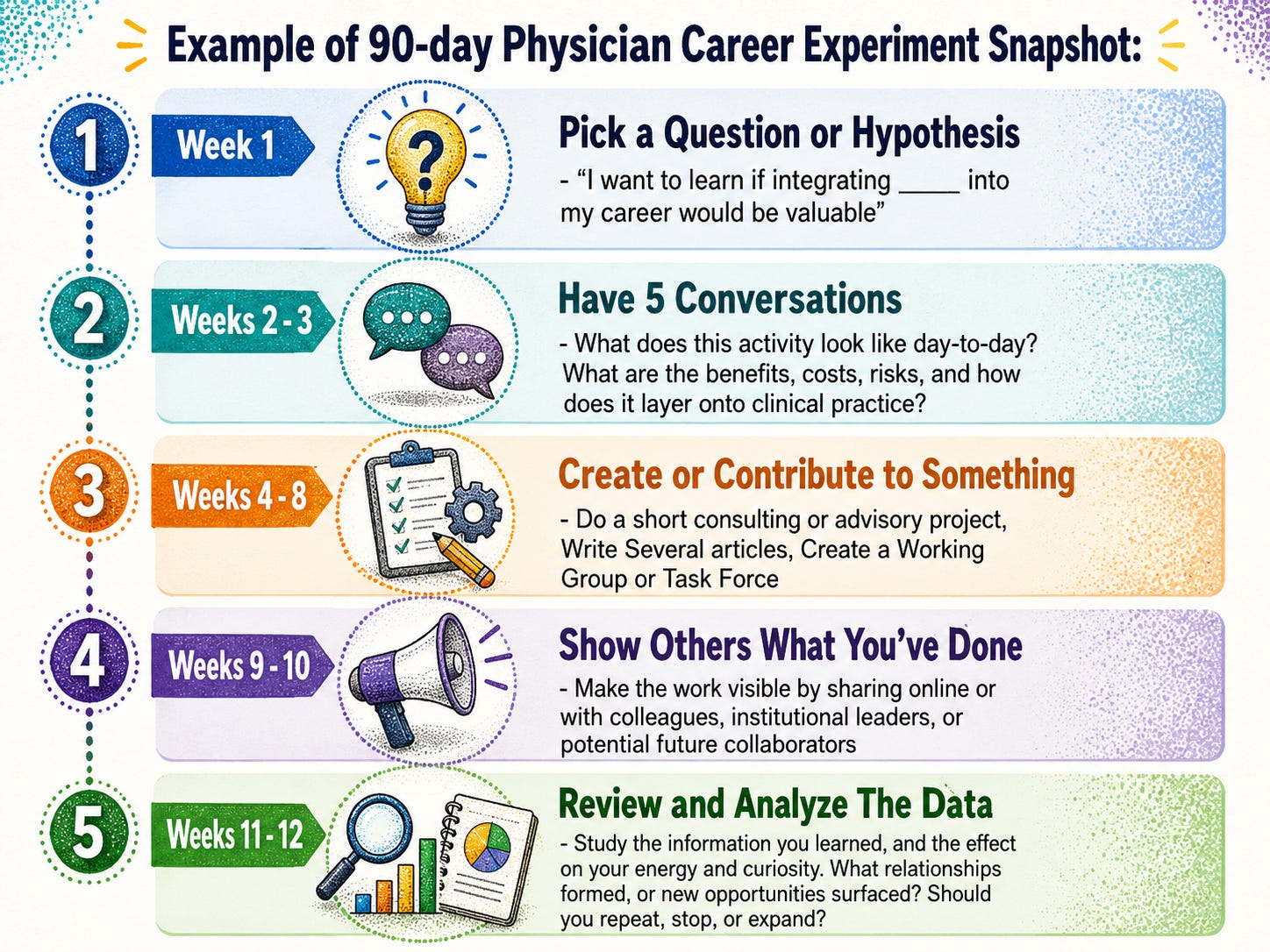
Even if the experiment doesn’t work or doesn’t become a permanent part of your larger body of work, it still provides useful data and can provide a new source of leverage. This is because you’ll have built up more knowledge, more relationships, and a better overall point of view. You may end up with a result that comes out of it that includes a publication or presentation, a speaking topic, or even just greater market understanding. Perhaps the most important of the things that will come is clarity about what to pursue and what not to pursue.
Ultimately, the key to moving forward in your professional discovery and redesign is that you don’t have to choose a specific future before acting. You actually create this future through making a hypothesis, running an experiment, testing, observing and gathering data, iterating, refining, and running the next experiment.
You don’t need a 10-year roadmap to start. You need a general direction, your best effort at a thesis, and a well-designed 90 day experiment.
So for the physician at the outset who had been pondering whether to pull the trigger on the idea they’d been mulling over for two years, the reality is that they don’t need to quit their practice, make a grand announcement, or enroll in a costly degree program. They need to articulate a good question and lay out a precise small test to run.
What professional decision have you been postponing because it feels like an all-or-none decision? What 90-day experiment could you design and run without abandoning your clinical work that would provide you with useful data? Let me know in the comments.
Scott F. Cameron, MD is a practicing radiologist, AI implementation leader, angel investor, and MRS Past President. He writes about physician career architecture at Physician Vantage Studio.
Love the "experiment" framing. It opens up more freedom, creativity, and permission to explore.
I enjoy that you made some visuals for this article, it summarizes and pulls out the key stages. By lowering the stakes using an experimental mindset, a physician can explore possible future directions safely while also sparking a new interest or skill.