

What if the most important career decision for a physician isn't which specialty to choose, but how much control you can build within it?
Dr. Bart Kaczmarek went from urology training to starting over in family medicine, and ultimately to designing a practice that looks almost nothing like the default model - one built around delegation, systems, autonomy, and an almost obsessive search for wasted physician time.
In Part I of our conversation, we trace how he transformed a two-room practice seeing roughly 20 patients a day into a radically different clinical operation, why he believes physicians often hold onto work they should give away, and the CRAFT framework he developed along the way. His story raises a bigger question for any physician who feels constrained by the way medicine is "supposed" to be practiced: how much of your current career could you redesign?
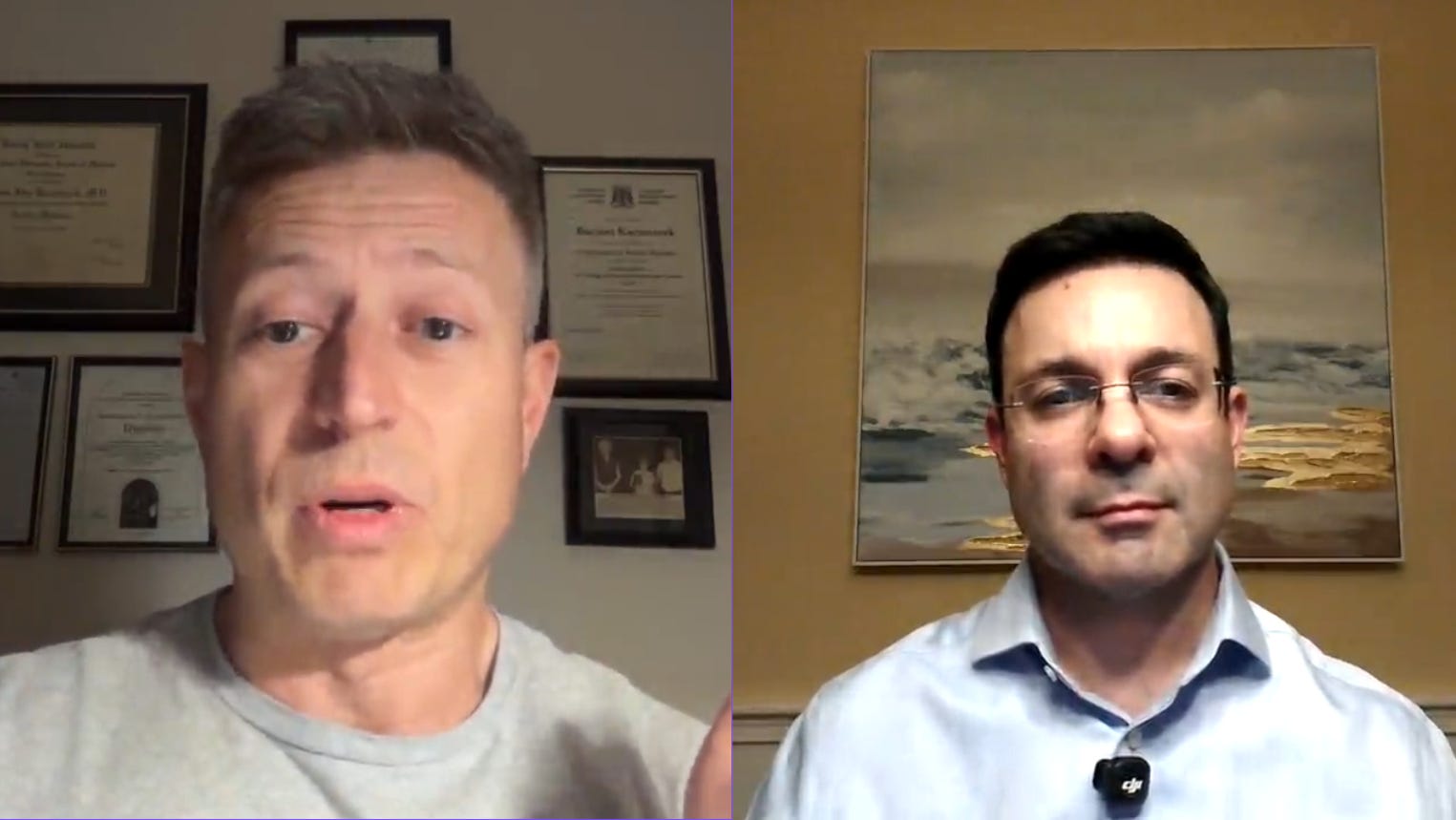
Physician Vantage Studio - Interview 01 - Dr. Bart Kaczmarek, Family Physician, Founder of DoctorFlow - Part I
Scott
Dr. Bart Kaczmarek, it’s great to speak with you and chat a little bit about your career journey as a physician, as a builder, and an innovator. It’s really nice to speak with you.
Bart
Very nice to be here, Scott. Thank you for having me on Physician Vantage Studio.
Scott
Thanks so much. So tell me a little bit about yourself - who you are and what you do.
Bart
I’m a family physician trained in the US at Henry Ford Hospital in Detroit. Right now I run an independent practice, seeing a lot more patients, more efficiently, than most doctors I know, on a much shorter work week with much higher leverage. Part of what I do is help other physicians discover that same capacity to work easier within the system that already exists. I also founded DoctorFlow, a software company that helps very busy, high-volume doctors turn over and process patients more easily, as well as LandmarkKnee, where I offer innovative treatment for knee pain and knee arthritis to patients from across North America.
Scott
Wonderful. So take me back to the early days of your journey, when you were training. I understand you did medical school overseas, and during that time you founded two music clubs, one of which was voted the best in the country in Poland. Tell me about that origin story - maybe the first time you founded something - and any lessons you learned that carried over to today.
Bart
I think that was the beginning of my journey, and it showed that I’m just curious. When an opportunity went by, I wanted to see what it was and what it might bring. Looking back now, I can see how wobbly and inconsistent those early efforts were - I was chasing shiny objects left and right. But in retrospect, it showed that I’m someone who’s interested and wants to reach for more. If there’s one good thing I take from that first venture, it’s probably that.
Scott
I love that - that innate curiosity from the early days clearly stuck with you as you went further down the road. I also understand that before family medicine, you did a urology residency, which is really interesting - we don’t run into many people who’ve done multiple training programs. Then after the urology residency, you did a robotic surgery fellowship, and after that, you started over in family medicine. Talk to me about that decision and what happened there.
Bart
You know what, I was just living happily in Poland, minding my own business, practicing medicine and trying to build something on the side, like I was describing. Then a woman showed up in my life who turned out to be Canadian - she was in the same medical school I had just graduated from. We didn’t actually meet in medical school; we met at a gym outside of it. We got married, and that brought me to where she was doing her residency, in Atlanta. Then I had to reinvent everything, because whatever training you do overseas doesn’t count here, which is fair - now I understand why, because the training is completely different, and I’m grateful for that second round of work on myself.
I tried to do a urology residency in the States, and one of the ways in was a program at Henry Ford Hospital in Detroit. I volunteered there for two years, then got into what was called a robotic fellowship. It wasn’t really robotic surgery - it was assisting with the robot - but it was basically like being a first-year surgical resident with a pager, assisting wherever I could. It’s a big name, but it was really more of a prelim year in surgery and urology, and that’s what eventually led me to family medicine.
Scott
Interesting. So when you made that transition to family medicine, was there anything you missed - a sense of ‘I wish I could still be doing some of the urology work’? Or did the benefits of family medicine more than compensate for whatever you’d left behind? How did you mentally handle that transition?
Bart
That’s actually an amazing question. It’s something I’m still amazed by - how deeply disappointed I was for a long time, all through residency in family medicine. I felt like I was disappointing myself, my family, all my friends who had done something ‘better’ than family medicine. For years I just felt inadequate, and that was the source of a lot of negative thinking. It wasn’t until recently that I realized something. Throughout my journey, I kept asking myself, what’s the best specialty? Maybe I should do another one. My mind went through all of it - maybe the best specialty is the one that makes the most money, or the one with the most prestige. But I’ve reached what feels like - and this may still change - the most mature answer: the best specialty is the one that gives you the most control. Being in charge of what you do, how you organize your work, how you want to work - completely. And family medicine is actually great for that. So now I’m the opposite of what I used to think. I’m grateful for where I am, because I realized I have this amazing ability to control my work, my fate, and my life.
“But I’ve reached what feels like - and this may still change - the most mature answer: the best specialty is the one that gives you the most control. Being in charge of what you do, how you organize your work, how you want to work - completely. ”
-Dr. Bart Kaczmarek
Scott
I love that perspective. Hearing you talk about it, there’s such a broad spectrum of what you can do within a given specialty, whether that’s family medicine or orthopedics or anything else. Two people practicing the same specialty can look totally different - almost as different as someone doing urology versus dermatology or pediatrics. As you said, it’s the way you do it. It’s what you bring to it, how you set up your practice, and so on.
Bart
Absolutely. In a hospital, your schedule, your procedure rooms - everything is bound to the hospital’s rules and policies. The wiggle room is very minimal. With outpatient medicine, and this is part of why I appreciate it so much, you can rearrange far more than people think. That’s where my ideas and my innovations come from - because once I saw that, I discovered a whole world.
Scott
That’s so interesting. Related to that - would you say that after you finished training and built your own practice in Windsor, control and autonomy were the reasons for going independent and setting up that practice environment?
Bart
Yes. For the first year or two, I was a senior staff physician at Henry Ford, at an outpatient clinic, and for the first few months it felt great - I’m not a resident anymore, I’m in charge of my own schedule, I can tell people what to do. You get this sudden boost of power. But then I realized how limited that actually is. If I got excited about doing more than everyone else, I quickly ran into the limits of the whole system. I’m not saying anything is wrong with that hospital or health system specifically - I think it’s generalized. You’re just limited by the whole structure. You’re in a rut, you have to follow the direction, and there’s very little wiggle room. That’s what attracted me to outpatient practice in Canada - I saw doctors here who looked so much more relaxed, so much more in charge. They’d be biking on the weekends, walking, doing their own thing. I wanted that too. So I went for it.
Scott
That’s so interesting. I’ve run into physicians like that too, with their own independent outpatient practices, and it’s fascinating how creative they can get with their schedule - blocking off a half day one week, taking a day off another week, really shaping it however they want. So moving forward to 2020 - I read that you took over a two-room practice seeing about 20 patients a day. Tell me what that baseline felt like.
Bart
Coming out of Henry Ford, everything had EMRs, and the buildings were at least spick and span. I might have complained the workflow wasn’t what I wanted, but everything looked nice. Then I walked into this building that looked like the 1950s - paper charts on the desk, like traveling back a hundred years. That was my first impression. I had to implement a local EMR myself. The reason I took over that particular practice is that it was tied to a payment model that was capped, and you had to take over an existing practice to get into that model, rather than starting from scratch. The opportunity was there, but the reality was a bit of a hit, given how far back in time it felt. Two rooms, one barely used, paper charts, and one secretary.
Scott
So a bit of a culture shock in some ways. Then the next year, in 2021, you hired your first nurse, and you’ve said that’s when your after-hours charting disappeared, or became substantially less. How did that work, and what specifically came off your plate when you made that hire?
Bart
I made the hire partly because I was also working at urgent care to support myself, which is a fairly easy thing to start in Ontario when you first move to Canada. I had a nurse there - a newer nurse - who anticipated what I wanted. She was caring, thoughtful, and helpful in ways I hadn’t even asked for. At that moment I thought, if I ever have my own practice, I’m hiring her. And I did. I called her, she agreed, and she still works with me today.
What I delegated started gradually, because in my model I’m stretching the boundaries of the traditional nursing role. My nurses now operate more like nurse practitioners in terms of how much responsibility is on their plate. I started with things like refilling prescriptions under specific guardrails, so I don’t have to look at or sign off on every single one - they start the note for me. Vaccinations, blood pressure checks - when I was at Henry Ford, I used to think, why do I have to be the one taking blood pressures and vitals? You can say it’s only a minute, but it’s a wasted minute. Someone else can do it for a tenth of the pay per hour. Why would the highest-value person in the room be doing low-value work? That always bothered me, so that’s what I started delegating first in my own practice. It seems small, but it took away a lot of the regular headaches of the day, and once you do that, the grind of the visits becomes much lighter.
“Why would the highest-value person in the room be doing low-value work?”
-Dr. Bart Kaczmarek
Scott
That totally makes sense. You were wise to use that person to the upper limits of what they could realistically do, and it sounds like they did quite a bit for you. A lot of doctors hearing this might have a knee-jerk reaction - ‘I can’t afford that, I can’t afford to hire someone.’ What would you say to them, and how does the math actually work out in year one?
Bart
Here’s my biggest example. I think the barrier isn’t logic - it’s emotion. It’s the attachment to the model where you feel you have to do everything. The easiest first move, which I describe step by step in a model I call CRAFT - we can talk about that later - is to release capacity from the doctor. The math is simple. I pay my nurse $25 an hour. Take paperwork as an example: one particularly extreme case is worth about $300 for 30 minutes of filling out a form, which we bill to patients directly. Theoretically that’s a $600-an-hour job. I pay her $25 an hour to do it, and at the same time I’m not doing it myself, which is the real issue for most doctors. A lot of doctors would say, ‘I don’t even want to be paid for that, just take it off my plate’ - and not only do you get that, you also get to play with your kids in the morning, or go fishing, and you still make money.
That’s the main principle. As logical as it is, a lot of my colleagues, when I show them what I do, agree with me logically but can’t get past the idea that the paperwork is theirs - that it has to be their pen checking that box, yes or no. I strongly disagree, and I try to show colleagues from every angle that holding onto it doesn’t make sense logically or emotionally. But emotions are hard to overcome. So doctors have to be ready for that.
Scott
That’s a good point. There’s a lot of emotion and inertia, and an assumption that things have to be done the way they’ve always been done. Unless someone sees a model exemplified, it may not feel intuitive that it’s even possible. But hearing you describe it, it makes total sense - why do paperwork if you don’t have to, and can free up time for higher-value activities or things you enjoy instead? That’s a great use of human leverage.
So eventually you took the clinic from 20 patients a day to 40, then to 80. Tell me how that went - what had to be true at each step before you could add the next set of rooms?
Bart
As I said, I engineered the CRAFT model as more of a reverse-engineering of how I actually progressed. It wasn’t a deliberate plan - it was just what felt intuitive at the time. I kept realizing I needed more capacity, patients were waiting, and eventually I moved to a location that now has about seven rooms plus two procedure rooms. I’ll occasionally use nine rooms, but usually it’s five, six, or seven on a typical day.
A lot of doctors will ask - if you’re seeing 80 people a day, what are you actually doing in the room? What kind of medicine is that? In my case, the quality metrics actually went up, not down. And for the patient, it isn’t a five-minute visit in the way people imagine, because I’ve unbundled outpatient care. I believe about 80 percent of what happens inside the room can be delegated, and close to 100 percent of the work that doesn’t require the physician in the room can be delegated too, and we can still bill for it.
“I believe about 80 percent of what happens inside the room can be delegated, and close to 100 percent of the work that doesn’t require the physician in the room can be delegated too, and we can still bill for it.”
-Dr. Bart Kaczmarek
So picture this: I don’t walk in to start the visit, I walk in to finish it. My nurses prep every patient - take blood pressure, do vaccinations, review preventive care, write me a note with the history and details of the concern, list out the concerns, prepare all the documentation. I haven’t touched paperwork in years. Everything is already taken care of, so I walk into an appointment that’s already about 80 percent complete. If a nurse can do that, imagine what a nurse practitioner or physician assistant could do. It’s almost like coming in for the last touch, the way an attending comes in after residents have already worked up the patient. Not exactly that, but close. You don’t need more than about five minutes on average - sometimes I’m there ten or fifteen minutes, but on average it’s a very short appointment because everything is already taken care of. So it’s a very different kind of visit, and a very different kind of 80-patient day, than what most people picture in outpatient medicine.
“I don’t walk in to start the visit, I walk in to finish it.”
-Dr. Bart Kaczmarek
Scott
That makes a lot of sense. It shouldn’t be framed as you doing everything for every patient - it’s about how you use every member of your team, together with you, to move through that patient panel. It also makes me think about how, the higher you go in a hierarchy, the fewer but more important the decisions are - like how CEOs are said to make only a handful of real decisions a day, and those are the ones that matter. It’s the same for you as a physician. You’re asking, what are the things that only I can and should address in this visit, and what can everyone else on the team handle? If something comes up they’re not sure about, I’d imagine they flag it for you. But everyone understands the goal: take as much off your plate as possible so you can stay mentally clear for the decisions only you can make.
“It also makes me think about how, the higher you go in a hierarchy, the fewer but more important the decisions are - like how CEOs are said to make only a handful of real decisions a day, and those are the ones that matter. It’s the same for you as a physician. You’re asking, what are the things that only I can and should address in this visit, and what can everyone else on the team handle? … everyone understands the goal: take as much off your plate as possible so you can stay mentally clear for the decisions only you can make.”
-Dr. Scott F. Cameron
Bart
Absolutely, you’re right on the money. Here’s a story I tell people. I do a lot of joint injections - I practice sports medicine as a family doctor as well - and local doctors refer patients to me for that. There’s no wait time; you can see me within the same week. I do probably 50-plus injections a week, sometimes more.
There’s a funny story I tell about this - we found the lowest-value task in my own workflow, the thing that gave me the most headache, and had someone else take it off my plate. It turned out to be that Band-Aids come individually wrapped in a peel-open packet. So now, once a week, my nurses’ job is to peel open all the Band-Aids ahead of time and put them in every room, so they’re already unwrapped when I come in. It’s a small thing, but it shows how I think about this. A new hire might think, ‘I don’t want to work with this guy,’ and that’s fine, but my team is used to it.
Scott
I love it, I love it.
Scott
That’s so interesting, and it makes me think again about the level of control you have in your practice, being able to tell your assistants, I want you to do this. I actually tried to institute something similar in my own practice. I do joint injections as well, and I told some colleagues, why don’t we have the people assisting us open the sterile packages and set up the sterile field, along with these other small tasks? There was some pushback - a few people said they weren’t sure they trusted someone else doing that. Which, again, gets back to that emotional thing you mentioned, assuming you have to do everything yourself. I said, look, it’s not that complicated - you can have a clear conversation and trust someone with it. But because we wanted one standardized policy for the whole practice, and a few people were uncomfortable, we defaulted to everyone doing it themselves. From my perspective, I was thinking exactly like you - why do I need to be the one unpeeling the wrapper off a syringe? It’s a small thing, but it adds up over the course of a day.
Bart
Yes, absolutely, and I think you’re right - that’s a good example of institutions being a bit of a barrier, because unless you get everyone on board, it’s hard to be the only one doing it differently, and it doesn’t stick. When you have fewer colleagues in the group, or run on your own, the key is to not be the guy who just decides unilaterally and expects everyone to comply. I have a close relationship with my team and we talk often. We hold biweekly huddles where they write on a board what’s bothering them, including things about how I do things. We treat it as problem-centered thinking together - how can we overcome this, how can we make this better, what was an issue for everyone this week. It’s a continuous improvement process, almost automatic at this point - we all see it as, we just have to keep getting better. It’s not that I’m fussy, it’s just the direction we’re taking, and everyone is on the same page about it.
Scott
That makes a lot of sense. So, Bart, take me back to the CRAFT system you mentioned a few minutes ago. You created it and make it available to other physicians so they can learn how to improve the processes in their own practice. Tell me about the different stages in that system.
Bart
CRAFT is an acronym. C is for Clean - prepare everything at zero cost. If you have a practice at any stage and you want to grow it, be more profitable, have fewer headaches, and implement more systems, this is systems-based thinking. It’s like having an old car that barely runs - you might as well clean the outside and pump the tires, because it doesn’t cost you anything. That includes raising all your fees to what you’re legally allowed to charge, going to the higher end of the bracket, being available online for things, creating templates, and more.
R is for Release. That’s the first hire you make outside your secretary, where you start delegating things - starting with the paperwork you get paid for. Releasing that capacity actually reveals hidden capacity that lets you hire the next person. It’s self-funding - one step funds the next. I now run a team of three nurses and three secretaries as a solo doctor. The most common model in Ontario is one doctor running one secretary, often not even a full one, since they’re usually shared. So I’m massively overstaffed by comparison, and a lot of visiting doctors ask, who’s paying for this? I tell them: the efficiency I discovered pays for all of it. I have no extra funding beyond what everyone else has access to.
“Releasing that capacity actually reveals hidden capacity that lets you hire the next person. It’s self-funding - one step funds the next.”
-Dr. Bart Kaczmarek
A is for Assembly - build a better, bigger team that helps you more and more. Once you discover that 80 percent of an appointment can be handled by someone else, you put more patients into that freed-up slot. That’s your next step. Some people choose to see more patients, like I did; others choose to work less and go home earlier. That’s their choice. I took it to the extreme, to see how many patients I could handle, and it’s gone really well.
F is for Flow. At some point, the geometry of your space stops working. For me, two rooms stopped working, then four rooms stopped working - too much backup - so I moved to a clinic I designed myself for efficiency.
T is for Throughput - find a way to measure your bottlenecks and keep improving, both the mechanical systems around scheduling and your team, so things keep getting better.
It’s available for free to everyone at craft.doctorflow.com. I encourage everyone to use it. I’d genuinely be happy if it stayed completely free forever. If more doctors use it, even partially, that’s the mission - I think we can all work better, more efficiently, and regain control over what we do.
Coming up next week in Part II… we’ll learn from Bart about the $250 first version of DoctorFlow, giving up a six-figure paper stake in a business for $1 in order to regain focus, what it’s like now to work roughly 25 clinical hours per week, and Bart's argument for what the real thing holding physicians back is - and a hint - it’s not time or money.
Scott F. Cameron, MD is a practicing radiologist, AI implementation leader, angel investor, and MRS Past President. He writes about physician career architecture at Physician Vantage Studio.
Thank you for having me, you made it so comfortable to converse! I would love if we all could become CEOs of our medical jobs! Here is a link to my weekly videos on how to build it step by step https://www.youtube.com/@DrBartKaczmarek
Scott and Bart. Absolutely inspiring conversation. I love that your workflow is adding jobs and patients with improved access and care delivery. This is completely opposite of what "leaders" would suggest and to be honest, what I would have said before reading and listening. Thanks for opening my eyes. Scott - keep these conversations going.