

Think about the next five things you’re about to do at work. Now think about a well-trained nurse, mid-level provider, or coordinator in your office available to you. How many of these five things could they reasonably safely handle and execute without you?
For a lot of physicians who do this exercise, it turns out that the number might surprise them and be higher than they expect. Depending on specialty - and this is anecdotal, not rigorously proven with data - is that up to a third to half of a typical clinical day may not necessarily need the fifteen plus years of training and licensure that preceded it. Few people have gone digging and looking for this information and figuring out where the line in the sand is.
One big reason is identity fusion with your medical license, which happens early in our training journey.
When you spend years gaining hard-won knowledge and experience that translates into the capability to diagnose and treat patients and interpret medical data, the credential can become a surrogate for the formal proof of your value. Many of us treat it as the whole source of that value, but it actually covers much less than that.
For example, Dr. Bart Kaczmarek, a family physician in Windsor, Ontario, showed me the application of this in his own practice. After auditing his own patient panel visits he noticed that roughly 80 percent of his office encounters didn’t require a physician to synchronously be in the room. Before he walks in, his nurses do an intake that includes vital signs, administering vaccinations as needed, review of preventive care, document the relevant history, and create a draft the documentation before he walks in. As he stated to me, in many ways he walks in to finish the visit, and gathering feedback from this intervention, he noticed that his quality metrics actually went up.
Even if your particular practice isn’t family practice, the general method still applies.
Why It’s Challenging to Do This Audit
Medical training is optimized to assess if you can do everything yourself - a full-stack top to bottom evaluation and treatment of a patient, and the associated follow-up and downstream care. Whether you should actually do all of the steps in that chain doesn’t necessarily come up, and the apprenticeship model (and it’s cousin - the ‘see one, do one, teach one’) treats doing each task personally as proof of competence.
Also, each of these tasks can be small individually, but take a lot of time and attention in aggregate. In other words, it’s not one particular form, one specific phone call, or one patient’s chart prep that feels weighty, and almost nobody considers all of these things, accumulated over a week’s time, together. Handing work off may come with a small feeling of guilt - as if there is something that you really should have done, but you wanted someone else to do it - and holding on to that thought that ‘you could have done it best’.
The Test
Here’s a simple test to run.
A task requires your medical license when the following two conditions are true: the outcome depends on judgment that took years to build, and the cost of being wrong is great enough that only that particular earned judgment will do. (and, of course, any tasks that legally require a license for that step)
Also, a practical third question can be added: would a well-trained mid-level provider / extender / assistant, if given the same information, reach the same action almost every time? If yes, that task is a candidate for possible handoff, whoever does it today.
Ask these questions related to your tasks across a full weeks schedule, because one day has variations and can be noisy. In radiology for example, the image analysis and associated decision making and recommendation are things that I do, while protocoling routine studies, flagging incomplete orders, and triaging non-urgent calls can be done by someone else. In hospital medicine, the discharge decision needs a physician, although putting together the paperwork doesn’t. Once you run the numbers, consider bringing it to your institution as a specific request regarding a potential hire.
What the License Covers
The license grants authority for a particular set of clinical actions. Fifteen years of practice gives you something more than this: judgment when there is ambiguity and incomplete information, an intuition when something doesn’t fit, and knowledge of healthcare workflows and understanding where bottlenecks are and when tools will not work when hit with real-world conditions.
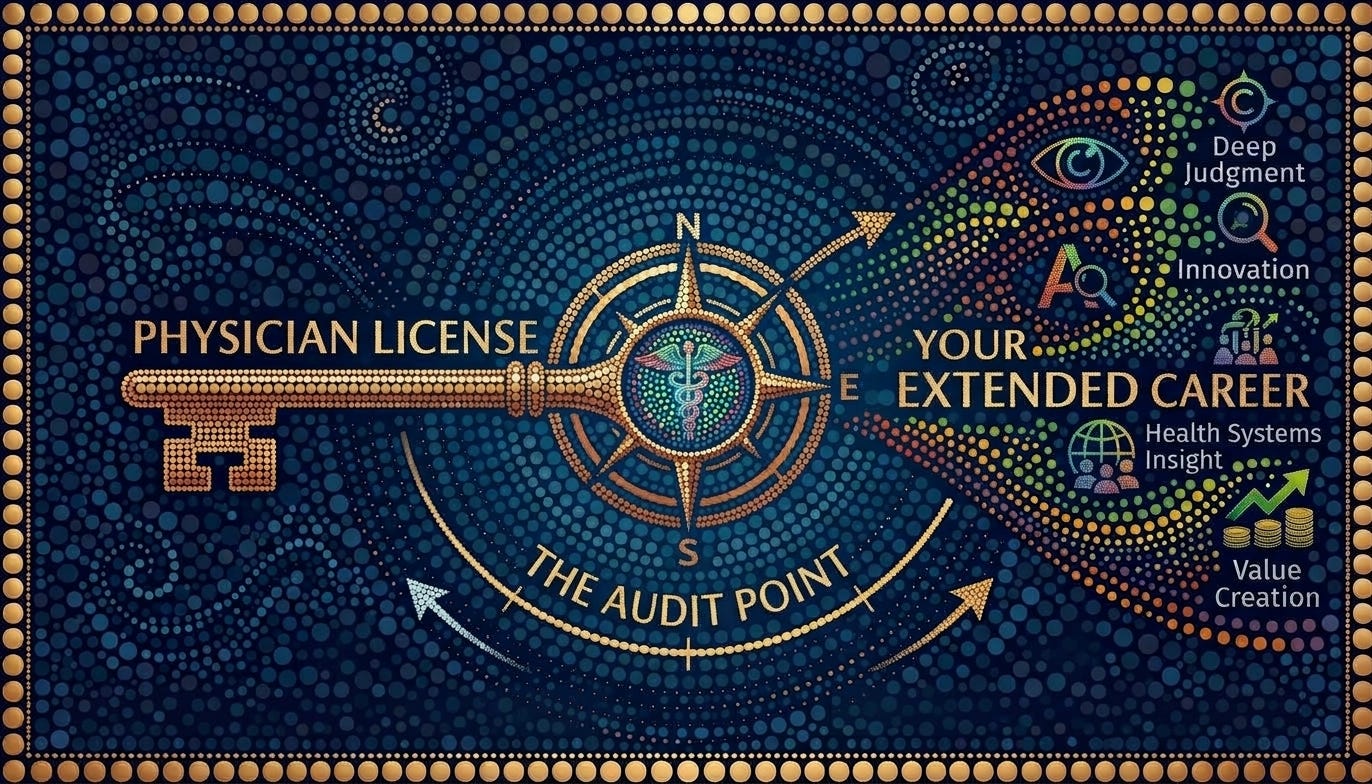
That larger body of expertise travels beyond the license and into your extended career.
The gastroenterologist advising a medical device company is valuable because she understands pathophysiology and clinical presentation of disease as well as the workflow, and how physicians will really use the product in the endoscopy suite. The radiologist evaluating an AI tool brings a working knowledge of diagnostic uncertainty, patient safety, and the true impact on diagnostic accuracy and confidence. The orthopedic surgeon modifying an operating procedure or OR process applies judgment earned over thousands of cases. A lot of that work happens without acting under the license at all, although all of it draws on what the license helped create.
Where To Put the Recovered Hours
If only part of your week actually requires physician-level authority and judgement, those hours are unusually valuable and deserve to be treated as scarce.
Recovered hours tend to fill with more of the same unless you intentionally put them somewhere else. Fill them with a bounded experiment, a project you’d like to work on, or a protected block of time that keeps your clinical work sustainable. Some physicians end up keeping 80 percent of their career in direct patient care, some choose 50/50, and some will keep a small clinical footprint while building something else elsewhere. The right answer is different for everyone. The important piece here is whether the structure came from default or from intentional design.
This isn’t to say that work that doesn’t need a license is of low value - some of the most human and impactful moments in healthcare take place with tasks a physician extender, nurse, or coordinator could technically perform. This audit shows where your scarcest resource is going, and what you end up doing with that data - and what you end up protecting - is your call.
Your Assignment for Tomorrow
At the end of the workday tomorrow, jot down the five tasks that most clearly didn’t need your license. Then, think about how you could reallocate those tasks.
Your license defines what you’re allowed to do clinically. Your career can draw on everything you learned by becoming a physician. Nobody will automatically hand you these hours back - you’ve got to go looking for them.
Scott F. Cameron, MD is a practicing radiologist, AI implementation leader, angel investor, and MRS Past President. He writes about physician career architecture at Physician Vantage Studio.