

I recently sat down with Dr. Olga Deengar for a conversation on her Coffee Playdate Podcast. We open with a coffee order and two rapid-fire games, then move into the substance: how Physician Vantage Studio grew out of a gradual path in my career instead of a single defining moment, how I found my way into advocacy and AI work through the people I met along the way, and why communities matter for physicians who spend much of their day behind the scenes. We also talk about the mindset shifts that helped me most, including managing expectations and allowing myself grace, the comparison trap that some entrepreneurs can fall into, a story about taking a chance on a founder who was just getting started, and my advice for anyone designing a next chapter. The full transcript is below, lightly edited for readability.
Olga: Welcome to the Coffee Playdate Podcast. I’m your host, Dr. Olga Deengar, and today I have a very special guest with me, Dr. Scott Cameron. Welcome.
Scott: Thank you, Olga. Great to be here.
Olga: I’m excited to get started. I always want to ask, do you drink coffee?
Scott: Yes, I do.
Olga: And how do you like your coffee?
Scott: Actually, I take it two different ways. On a weekday, I take it black and put in some MCT oil, which is medium chain triglycerides, which I’ve heard is a healthier way to take your coffee. On a weekend day, I splurge a little bit and have cream and sugar. So it depends on the day.
Olga: Very nice. Do you still add the MCT on the weekends too?
Scott: I don’t, because I found that it does not mix well with cream. So I have to pick one. I have to pick being a healthy coffee drinker or a more indulgent coffee drinker. Which one is it?
Olga: Well, I like your strategy. Indulgent on the weekends. Awesome. Our first game is called Rapid Fire Questions. I’m going to ask you to choose between one answer or the other. You don’t have to explain why, just go with your gut instinct. Ready? First question: a traditional promotion or a self-created opportunity?
Scott: Okay, I’m ready. A self-created opportunity.
Olga: Cool. Next one: being known as an exceptional clinician, or being known as a clinician who creates new possibilities for others?
Scott: I would say being known as a clinician creating new opportunities for others.
Olga: Beautiful. Next one: one big professional reinvention or many small career experiments?
Scott: I’m a big advocate of many small career experiments.
Olga: Great. And the last one here: AI as a productivity tool or AI as a career design tool?
Scott: AI is a career design tool.
Olga: Awesome. The next game is similar, except now we both answer, and if our answers match, we take a sip from our coffee cups.
Scott: Okay, I’m ready to roll.
Olga: The first one: reading a great essay or recording a great podcast conversation.
Scott: I would say recording a great podcast conversation. Cheers.
Olga: Me too. Cheers. Second question: a long weekend away or a full unplugged week?
Scott: Tricky one. These days, I’m really pining for that full unplugged week. Cheers.
Olga: Yes. Me too. You get more days with that, right? Cheers. Next one: one beloved destination again, or a completely new place every single time?
Scott: A completely new place every single time.
Olga: Yes, me too. There’s so much more to explore in this world. And the last one: a career chapter that felt comfortable, or one that really stretched you?
Scott: One that really stretched you. That’s better for the long term.
Olga: Yes, me too. Here’s to stretching.
Scott: Cheers.
Olga: All right. So Scott, can you tell our listeners a little bit about yourself and the amazing work you’re doing?
Scott: Sure. I’m a radiologist, and my practice is in the greater Boston area. I do pretty much the full spectrum of radiology. I read X-rays, MRIs, CTs, and mammograms. I also do some procedural work, specifically barium studies and joint injections for pain relief, as well as joint injections before an MRI or CT scan.
I also do a variety of things at my institution from the leadership perspective. I sit on my institution’s AI advisory board, and I help evaluate potential AI technologies that we want to integrate into our practice. I’ve also served in leadership roles with our state medical society, the Massachusetts Radiological Society, where I’m a past president, and I’ve been involved with national committee work with the American College of Radiology. I also do some work with clinical trials, including both AI technology development and oncology drug development. I’m a radiologist reader for those studies.
The newest thing I’ve layered onto all of that is my new business venture, Physician Vantage Studio, which helps mid-career physicians explore the different things they can do with their medical background while keeping their medical foundation. Think about expansion within medicine as opposed to leaving medicine. I help them evaluate opportunities, relationships, and the expertise they have, and ways to use those to create a more fulfilling, flexible, and durable career.
Olga: Wow. You have your hands full. So tell me a little more about what sparked the idea of creating Physician Vantage Studio.
Scott: It wasn’t one sentinel moment where one thing happened and I said, okay, now I’ve got to do this. I think it built gradually over time, as I realized the trajectory my career had taken to get to where I am today. As satisfying as my medical career is, I realized at a certain point that I was only going to be able to achieve so much in it, in terms of not just how high up the ladder you can go, but how much fulfillment you’ll get from those particular clinical activities. At least that’s the way it felt for me. I always felt there was more within me that I could do, and other skills I could bring out and use in different and interesting ways.
I started to do that gradually as my career went on. For example, at one point I started to integrate advocacy work into what I call my professional portfolio. I got involved with my state medical society and helped advocate for causes that are important to patients and physicians. I realized that created an interesting activity that was complementary to my clinical practice, and the two fed each other and made each one better. In similar fashion, when I started doing some of the AI work, that also used my brain in a different way and provided a spark of interest and variety on top of my clinical work. Again, it was complementary to what I was doing in the clinic.
As I started to layer on those experiences and realized how far I’d come from my first job, practicing as a radiologist in the hospital, I said, I really want to explore this further. How are we doing this collectively as physicians, and how can I help other physicians go on that journey and create rich experiences that complement what they’re doing as a physician? How can I help make their careers more fulfilling, flexible, and durable, without saying, you’ve got to completely blow up your career and leave it behind?
So for me, it’s a culmination of a gradual path I’ve been on for a number of years.
Olga: That’s fascinating. How did you know what you were interested in? How did you know you wanted to do more advocacy or AI work? How did you figure it out?
Scott: I figured it out by doing, and through my network and the people I’ve met along the way. A lot of it is serendipity, being in the right place at the right time, bumping into people and seeing what they’re doing. Also, once you get good at building out your personal skills and your personal brand and sharing what you’re doing, people start to approach you with opportunities.
But a lot of it for me, Olga, was somebody I bumped into, whether in my practice or at, let’s say, a state specialty society meeting, telling me, “Hey, I’m doing this particular activity.” And I said, “Hmm, that’s interesting. Tell me about that. What do you do there, and why do you like it?” A lot of it was chance encounters that just happened. Starting a handful of years ago, it became more intentional. I started to reach out to more people and say, “Hey, I’ve noticed that you’re doing this. Can we set up a time to talk? I’d like to learn what you’ve done, what you’ve learned, and any advice you might have for me.” I think it all starts with seeing personal examples of people doing something and engaging with them.
Olga: It sounds like you’ve gone to multiple conferences and are part of multiple communities. What value do you feel you get from being part of communities of like-minded entrepreneurs?
Scott: I think it’s very valuable. We tend to become fairly insular in our profession on a day-to-day basis, especially physicians who work behind the scenes. If you’re a radiologist, a pathologist, maybe an anesthesiologist, it depends. A lot of us either interact only with patients and support staff, or we interact with computers for a large part of the day. You can have your blinders on and not know what other people are doing. When you have a community and other people you can talk to, share ideas with, and bounce things off of, it helps to motivate you, and it also provides feedback you otherwise can’t get. It’s very valuable to talk to somebody such as yourself and say, “What do you think about this thing I’m thinking about or trying to bring to life?” Having that gut check from someone else who’s also a physician, a physician entrepreneur, whatever the case may be, adds a lot of value.
For people just starting out, it’s especially important, because you need that activation energy to actually put yourself out there. If you don’t have anyone and you’re just doing it on your own, that can be a tough hurdle to clear. So the earlier you are in the journey, the more you need it. The later you are, maybe the less you need it, but it depends. Once you’ve got that trajectory and roadmap laid out, you need it maybe in pieces here or there, but particularly in the early days.
Olga: In the early stages, it’s really important to not just set a goal, but actually follow through with it. Like you said, you can say, “I’m interested in real estate,” or “I’m interested in getting into venture capital work,” or “I want to do more expert witness work,” whatever your supplementary side hustle may be. You can say, “I’d like to do that,” but actually taking that next step toward it is the hardest part for someone who’s starting out to overcome.
Scott: I agree with that. There’s a definite initial resistance that a lot of people have to face. Part of it is resistance, part of it is fear, part of it is worrying about what other people are going to think, and part of it is imposter syndrome. There are all these different things working against you. There’s also identity. I talk about that in some of my writing: we’re so solidly attached to the identity of being the great clinician, providing great clinical care. If you want to put on a new hat, whether that’s a physician entrepreneur hat, an investor hat, or an AI leader hat, you have to have the confidence that you can do that. If you have other people around you showing you, “Hey, it can be done,” it’s a lot easier.
Olga: Yes, the power of community. It’s beautiful. Let’s talk about the mindset shifts you needed to make as you were starting out on your entrepreneurial journey. What were some of those shifts?
Scott: One of the biggest mindset shifts was my expectations for what success looks like. We see a lot of people out there with successful businesses, or doing something healthcare adjacent, and you have a hard time making the jump from where you are today to where you want to be, and drawing that connection with that other person. So the mindset shift I had to make was to try not to think so much about how I’m going to get from here to there. Think about the big picture, but also about how to get from where I am today to the next checkpoint, the next milestone. Set my expectations around that, and develop a plan. That meant moving away from the mindset of “I’ve got to be successful by hitting this long-term milestone.” So for me, it was about managing expectations.
Another mindset shift, related to that, is allowing yourself some grace when you fall off the path or don’t do things perfectly. At least for me, I’m very much a perfectionist. I like to get things right and hit all the goals. When your best-laid plans make contact with the reality of the clinical day, your family, and the other obligations you have, it’s not going to necessarily play out the way you said it would. You’re going to have setbacks, you’re going to have moments of self-doubt, and all of those things are real. Shifting to the mindset of “do your best,” and understanding that you’re still able to get back on the horse and keep going, was a huge shift for me.
Olga: Those are really great mindset shifts, because it’s not easy to recognize that from the get-go. We’re always so goal-oriented. We’re perfectionists; we kind of have to be. It’s part of our job and part of our training. To step back from that and say, “This is where I want to be X number of years from now, but let’s chunk it down. Let’s figure out the weekly action steps and then the daily action steps I need to take to get myself there.” And you’re right, you have to have some self-compassion too, because you will have bad days and good days. The bad days will make you feel like you’re way behind, and you’ll completely overlook the great, very productive days you’ve had. There’s always a different lens we look through whenever we’re faced with a challenge.
Scott: Exactly.
Olga: So, speaking of challenges, I’d love to know about a challenge you faced on your entrepreneurial journey. How did you overcome it, and what specifically did you learn from it?
Scott: One challenge I faced is something I’m going to call the comparison trap. It’s when you’re working on something, as I’ve been working on this new venture, and the more you work on it and look out there to see what other people are doing, your competitive analysis, so to speak, you eventually see some overlap with what other people are working on. I think that’s natural and unavoidable. In any domain and any business, there’s going to be some overlap between what people are doing. That’s not a bad thing. In some cases those can be complementary, and people can work together or inspire each other.
But for me it was a challenge, because sometimes I would see somebody working on something and say to myself, “Maybe I can’t do my version of this, because it’s already been done or because someone else is doing their version.” That became a big mental block. I asked myself, “How do I change what I’m doing? How do I search for something totally unique, a totally unique offering?” That’s very hard to do, because there’s always going to be somebody out there doing something related in some way, shape, or form.
So I had to get past that. The way I did it was to not worry about what other people are doing, and not even necessarily look into it. I focused on my own work, the things I want to create, and the value I want to bring to people. I let it speak from my heart. I let it be something where I say, “This is what I’ve learned from my personal experience and what I want to share.” If it overlaps with what somebody else has experienced, so be it. I’m allowed to say what I want to say and put my own perspective and value on it. For me it was about getting rid of those distractions, to help me focus and get the momentum behind what I’m working on.
Olga: I’m curious, how did you get rid of some of those distractions? Did you unsubscribe from newsletters, or use an app to block your access to Facebook or Instagram?
Scott: That’s a good question. It’s hard to get rid of all those distractions. Part of it for me was the mechanics. For example, on LinkedIn, where I post some content about what I’m working on, I actively decided not to read some of the other posts LinkedIn suggests for me, because it sends me down a tangent. I get it. The algorithm is saying, “Here’s some content that’s related to what you’re talking about. Maybe you might be interested.” But I found that was largely a distraction for me, at least where I am right now, so I actively decided not to look at those things. The second piece is that I decided to do less Googling and searching, and focus more on me, my business, and what’s in front of me right now, and again on that roadmap of what I want to hit and get done. I put on my blinders and focus on that.
Olga: It’s really hard to do. Easier said than done for sure, but I’m amazed you were able to do that. That’s really great. I want to shift gears a little. Tell me about an experience where you’ve gone above and beyond for somebody. Maybe it was a family member, a loved one, your team, whoever it was. How did you create a very meaningful, extraordinary experience for them?
Scott: Let me think. I’ll answer by saying I don’t think there’s one specific example, but maybe a few that, combined, add up to something meaningful and extraordinary. As I’ve become more vocal about what I’m working on, I’ve seen people reaching out to me for advice on how to pursue a decision, or make a decision, about where they are professionally. I’ve been receptive to that, talking to those people openly and helping them out. And actually, as I’m talking about it, I can think of one example.
Someone reached out to me, a patient who, long story short, had a bad experience on her healthcare journey. She almost got harmed in the process, but she recovered, and she decided to build a business around it. It’s centered on patient-doctor communication and how we can improve that, and that’s very central to her business. She reached out and said, “I’m starting this podcast, and I’d love to get your perspective, because you’ve been involved in some quality and safety initiatives in the past. Would you be willing to share your story and help me promote what I’m working on?” It was very early for her. She had only done a few of these podcasts and interviews, and some of them weren’t with physicians. I said to myself, “I’m going to give her a chance. I’m going to help her out and help her spread her message. It’s a worthwhile goal.”
Long story short, she was super appreciative. We did a nice interview, and I published a version of it on my website under the conversations section. It was a nice conversation that didn’t take a lot of my time, but it was so meaningful to her to be able to say, “There’s another physician out there who believes in this mission and this cause, is willing to sit down with me, support me in the early days, and take a chance on me.” I think that went a long way for her. I believe that was a meaningful and exceptional experience I helped to create for her, and it didn’t take a ton of input from me other than saying, “I’m ready and willing to do this with you.”
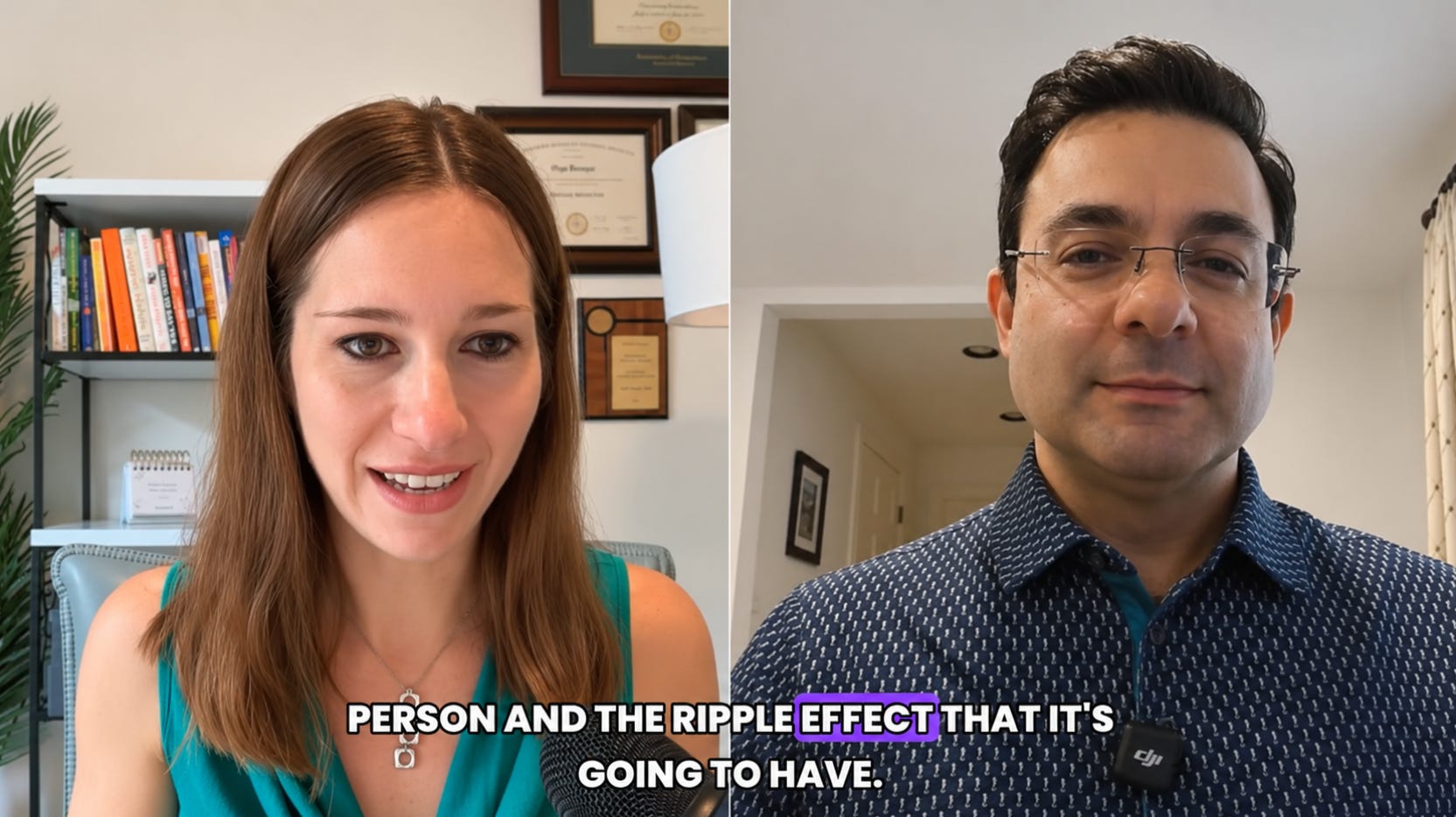
Olga: There’s so much power in those small moments. You really don’t know which conversation is going to impact the other person, and the ripple effect it’s going to have.
Scott: Absolutely. Sometimes you need someone to take a chance on you, and I think that’s what she felt. That helps get the snowball going. I like to be that person who can help someone get the ball rolling, get things off the ground, and be a source of support. I’ve found in my life that people do that for me as well.
Olga: You’re a momentum starter. So Scott, what advice would you give to someone else who may be starting out in a similar space?
Scott: That’s right, I like that. The advice I would give is to look at things from the biggest-picture perspective you can. A lot of people hear about an idea, something they could do, and they latch onto it and go down the rabbit hole. I would advise taking a wider perspective and looking at things holistically. Where am I in my life? What do I want to achieve short-term, mid-term, and long-term? What have been the things that are valuable to me? Perhaps map out your core values and ask how you’re expressing them in your daily life, and how it all fits together. For me, as a physician and as a person, whether you’re a husband or a wife, a mother or a father, how do those things all fit together? Then decide what the next piece is that you want to layer on from an experience perspective, and why. Then you tackle that.
I think you should be able to make a coherent argument for why you’re looking into doing a particular thing, instead of just saying, “That sounds interesting,” or “Someone else is doing it.” There’s value in doing those things directly, but I think you should make it a bounded experiment. Otherwise you can get caught up doing that thing for years, and then realize down the line, “Wait a minute, why am I even doing this? Why did I start?” So my advice is to start big and then drill down.
Olga: I love that. It’s basically looking at the reasons you want a particular outcome, then honing in on the values behind it, and making sure all of that is aligned. Only then can you map out the action steps you need for each goal. Beautiful.
Now, a lot of our listeners like to read books. Is there a particular book you’d recommend for entrepreneurs who are just starting out?
Scott: One I like is called The Perfect Week Formula, by Craig Ballantyne. I like it because he lays out how to structure your week and set yourself up for success. There are some good visualization exercises in there, like how to run a video in your mind of what a successful week will look like, your highlight reels, and some structural pieces behind it. I’d recommend it again to folks. It’s called The Perfect Week Formula.
Olga: That’s a great recommendation. I haven’t actually heard of it, so I’m going to put it on my to-read list. Great. And Scott, I always like to ask my guests to share where our listeners can find them if they want to connect.
Scott: Great. I recommend people go to my website, physicianvantage.com. On that site I have a collection of essays and frameworks about how physicians can build career options with more leverage, more control, more flexibility, and durability. I have some conversations I’ve recorded with other physicians there as well, and a free document about the five forms of physician leverage and how you can use them in your life. I’m also going to be releasing a new tool on the site, which should be very interesting for folks as they think about the next step in their career evolution. That tool should be live any moment now, so feel free to go to the site and check all of that out.
Olga: That’s excellent. Thank you so much, Scott. We had such a great conversation today. It’s been a pleasure having you on the Coffee Playdate Podcast. I hope you have a great week.
Scott: Thanks so much, Olga. It’s been great talking with you.
Thank you to Dr. Olga Deengar for the thoughtful questions and the generous conversation. If one idea from this interview stays with you, I hope it’s this: you can expand within medicine by running small, bounded experiments from a clinical foundation you already trust, starting with the biggest picture of your life and drilling down to the next step worth taking. If you want to go deeper, visit Physician Vantage Studio for essays, frameworks, recorded conversations with other physicians, and a free document on the five forms of physician leverage. And if this conversation sparked something for you, share it with a colleague who is thinking about their next chapter, or reply and tell me which small experiment you are considering.
To learn more about Olga, see:
Website: https://coacholgamd.com/
Instagram: https://www.instagram.com/coacholgamd
LinkedIn: https://www.linkedin.com/in/olga-deengar-243967359/
Facebook: https://www.facebook.com/profile.php?id=61582886393590
Scott F. Cameron, MD is a practicing radiologist, AI implementation leader, angel investor, and MRS Past President. He writes about physician career design at Physician Vantage Studio.
Expanding within medicine rather than feeling you have to leave it behind is an interesting idea. The next chapter begins with a small experiment, a conversation, or simply seeing what’s possible. What you present is an important reminder that our professional identities can grow, too!
“Make it a bounded experiment” is the line I'd underline. Writing down what a new layer has to show you, and by when, keeps it from quietly running for years before anyone asks why it started.