

Dr. Mona Sodhi hosts Super Doc Stories. I joined her to talk about my path through radiology, why I traded a partnership for flexibility, and what I am building at Physician Vantage Studio. The conversation below has been lightly edited for length and clarity.
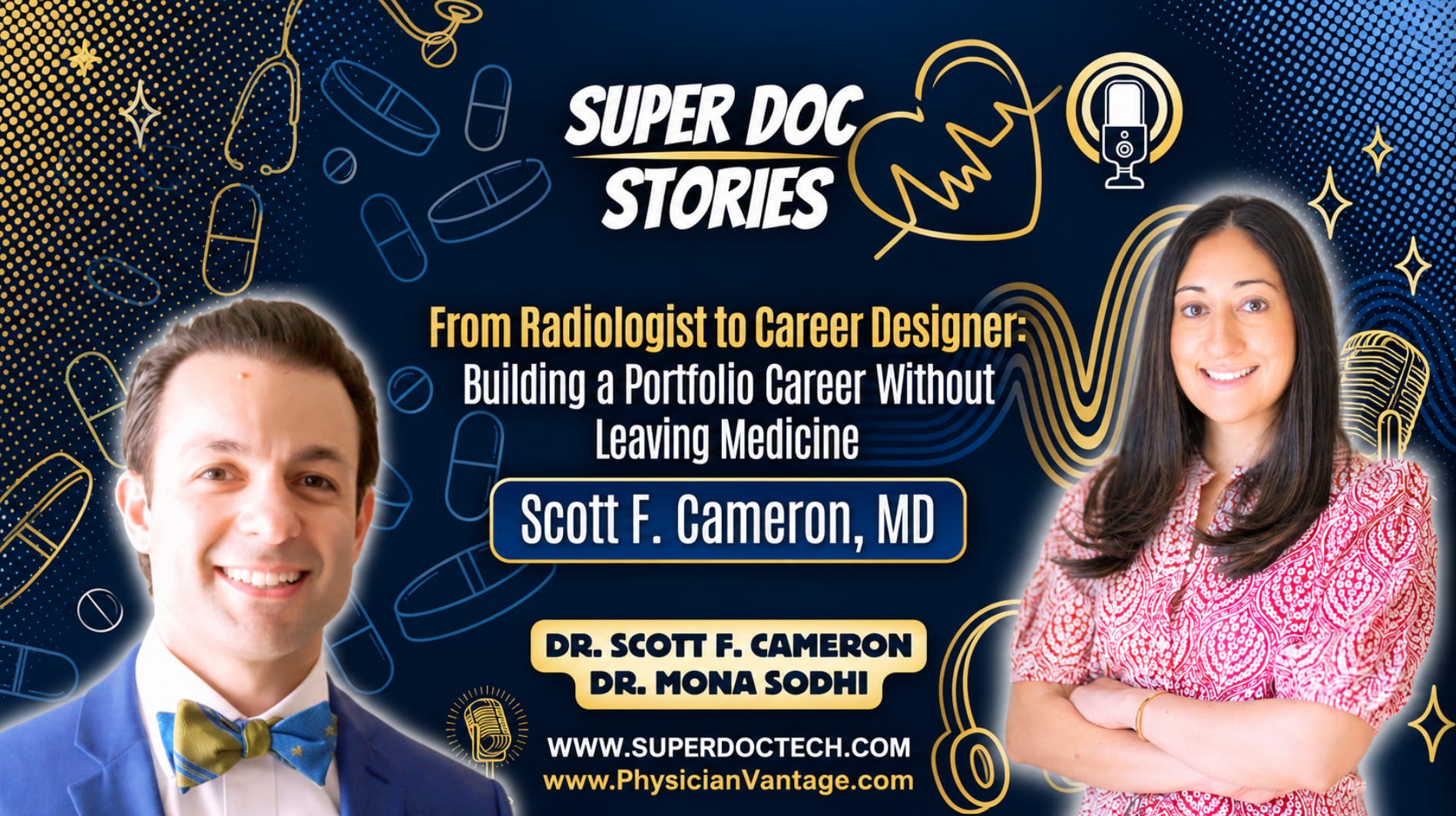
Dr. Mona Sodhi: Welcome to Super Doc Stories. I’m your host, Dr. Mona Sodhi, and today I am so delighted to have Dr. Scott Cameron on the show. Scott is a practicing radiologist in the Boston area, and he is building a really cool platform focused on physician career design. I’m so excited to hear about it. Welcome, Scott, to the show.
Dr. Scott Cameron: Thank you, Mona. Great to be on Super Doc Stories. Thanks for having me.
From partner to employed radiologist
Dr. Mona Sodhi: Great. Thanks for being here. We were just talking offline, Scott, about how you already know my business partner, Marissa, but this is our first conversation, and I’m really looking forward to learning more about the platform you’ve built and how you yourself have achieved physician career design. But take me back, Scott, to your career as a radiologist and what that has looked like up to this point.
Dr. Scott Cameron: Great. I’ve been practicing as a radiologist in the Boston area for about the last 10 to 15 years. I started out in private practice and worked my way up to partnership. Then I joined a different private practice and again worked my way up to partnership. Most recently I joined a practice where I’m an employed radiologist. Part of the reason I made that shift was increased flexibility with my schedule and better hours. When I did that, I was able to layer on additional experiences that were valuable to me outside of my clinical practice, and I added them one by one. It started with advocacy work. Then I got involved in artificial intelligence, did some clinical trials work, and took on a variety of other things and leadership roles.
I realized my eyes were opening to what you can do outside of regular clinical practice, and how many physicians, caught up in a busy day-to-day, don’t realize the other things they can do with their medical degree. So I started to think: why do we have this issue where we’re very accomplished and very skilled, but we get caught in a rhythm of doing the same thing over and over? What makes certain physicians realize they can do different, healthcare-adjacent activities and leverage that MD in different ways?
As I thought about the next step in my evolution, I came up with the idea of a career design platform, which is called Physician Vantage Studio. The central thesis is that many of us as physicians have different skills, expertise, relationships, and credibility, but we’re not taught how to see those or how to activate them. My goal is to help physicians do that so they can create more fulfilling, flexible, and durable careers without feeling like they have to leave medicine behind.
Dr. Mona Sodhi: Oh wow, I really love that. You’ve hit on something a lot of us are feeling as practicing physicians, where we feel like there’s a ceiling and we’re only allowed to operate in the system that’s been handed to us. A few of us, myself and you included, have realized, “Hey, I can use my natural abilities to build something healthcare adjacent.” That’s a great way of putting it.
And now you’ve created this platform to help physicians realize their potential and step outside their typical 9-to-5, or let’s be honest, probably 7-to-6 career, and build something for themselves, for legacy purposes, whatever it may be, while still participating in clinical hours as they have been. What stood out to me is that you made partner twice and then chose to be employed. Tell me about that pivot. I suspect it had something to do with the balance and the career design you wanted for yourself.
Dr. Scott Cameron: Yes, that’s right. There were a lot of factors, but one of the biggest was realizing that when I was a partner in a hospital-based private practice, I wasn’t doing the work the way I wanted to be doing it. It was something I defaulted into, which a lot of physicians do outside of training. There were a lot of very busy on-call shifts that got very stressful, and the hours were long, with long days running into nights and frequent weekends. I asked myself, “Why should someone else’s idea of what the day and the week look like govern my life?”
So I started talking to people, and I had an almost serendipitous encounter with one of my current colleagues at a Quality and Safety Council meeting where I was volunteering. He represented his practice and I represented mine. We got to chatting, and he opened my eyes to his practice, an outpatient multi-specialty practice with different hours and a somewhat different case mix, but one that still allowed me to practice radiology the way I wanted to: reading multimodality, multi-body-part imaging and doing procedures. I didn’t know a practice like that existed until I bumped into him. I thought, “Wow, I can use my skills in a similar way, but in a better structure.”
That’s what led me to give up the partnership position, and what I gained was the hours, the lower stress, and so on. It had many beautiful downstream effects. It exposed me to other people and ideas, and it gave me time to interact with different people in the healthcare ecosystem. The rest is history. I’ve done everything from angel investing to leadership in my state medical society to serving on an AI advisory board at my institution. A lot came from freeing up that schedule by being willing to say, “Okay, let me shift into a different structure.”
Dr. Mona Sodhi: That takes a lot of courage. Ownership in general is one path to wealth, and one of the best paths is having ownership, whether in your own company, your own private practice, in real estate, whatever it may be. But you said, “This piece of ownership is draining me. It’s not allowing me to expand.” It took time and energy from you. Having the ability to see that is very unique, because a lot of physicians are on a one-way path to, “I’m going to be a physician partner, and that’s the pinnacle of my success and the answer to everything.” It’s not always the answer, so it’s important to be able to pivot and shift gears when you need to.
It sounds like it also gave you the bandwidth to think of the platform you’ve built. So, Scott, I’d love to know more about what you’re building and what your vision is for your company.
What Scott is building
Dr. Scott Cameron: Sure. One thing I want to tack onto what we were just discussing is that changing practices also freed up more time for my family. When I was a partner in those private practices, I was single and had no kids, but I knew one of my life goals was to settle down and have kids. Thankfully I’ve been blessed to be in that position today, and I’m really appreciative that I can spend time with my two young kids. I was happy to make that trade and realize that’s where my values were.
As for the platform, right now it’s very much in the development stage. What I’ve been doing is primarily writing about topics related to physician career design and how physicians can use their expertise, credibility, and networks. I’ve published about 15 long-form articles on my website covering these different aspects. They include a handful of frameworks for physicians to use as they work through different issues. One example is a career experimentation framework, which is how you would run a 90-day career experiment to decide what to do next, as opposed to putting pressure on yourself to answer “What am I going to do next?” when you feel you’ve hit a ceiling in your job. I want physicians to know there’s a structured way to do that. Another is what I’m calling the Portfolio Physician model, which is about integrating different healthcare-adjacent pieces into your clinical work and structure so they feed into each other and are synergistic.
I’ve also started a conversational series where I talk to physicians who are doing the kinds of things I find interesting, meaningful, and durable from a career standpoint. We get real-life examples of how they created those experiences. One is a physician who spun a company out of his radiology practice and has now launched a VC fund while still practicing clinical medicine. Another is a family physician who built and grew his own practice.
How physicians would work with him
Dr. Mona Sodhi: I love that. You’re opening up a lot of dialogue in written form and having real conversations with physicians going through this as well. You’re starting with, “How did we get here? What are my reflections on it? What’s the best way to build a path forward?” And I love that you have this lab for people to think, “I don’t have to change my career, but I can play with it and try a different version of it for 90 days.” That’s a digestible way for physicians, who are built-in perfectionists, to say, “I can do that. I don’t have to completely change my career; I can just see what it could be like.”
So how do you envision this working with the physician? Would you call them clients or members of a community? How would you let them work with you?
Dr. Scott Cameron: What I envision is creating an opportunity for physicians to work more actively with me to diagnose where they are in their career and identify concrete next steps, and to guide them through that process. I’m still putting together what the structure will look like, but it could be a live cohort, or a series of exercises and workshops that physicians go through with me to get tangible answers and next steps they can apply in practice.
Dr. Mona Sodhi: And in what capacity do you see them working with you? Is it a long-term relationship, or more consultative?
Dr. Scott Cameron: I see it as a bounded relationship over a set period of time, perhaps a number of weeks, where we work together toward the end goal of figuring out practically what they would do, what the next steps are, and how to implement them. So it’s a time-defined engagement with desired outcomes at the end.
Inside Physician Vantage Studio
Dr. Mona Sodhi: What I really want to know more about is the platform you’ve built. Tell me the name and what your vision is for it.
Dr. Scott Cameron: Sure. The platform is Physician Vantage Studio, and it’s built around physician career design. The goal is to help physicians understand the different sources of leverage, expertise, and credibility they have, and how to use them to create more flexible, fulfilling, and durable careers.
Right now it’s very much in the development phase. I started by publishing a series of long-form essays on themes that matter to physicians: what to do about AI in physician careers, how to think about physician identity and create different sources of optionality, and how to run career experiments instead of making bold career changes. I’m up to about 16 essays, published weekly. Some are framework essays, which give physicians a way to apply more of a process to a particular issue or challenge. The 90-day career experiment framework is an example. It walks you through running a career experiment instead of making a huge shift or blowing up your career. Those are more than conceptual. They’re things physicians can actually use.
Then I launched a conversational series where I talk to physicians who embody what I call the portfolio physician, someone doing and providing different options. One is a radiologist who spun a company out of his work and launched a VC fund, all while still practicing. Another is a family physician who created an innovative way to become more efficient in his clinic and see more patients. I’m talking with physicians about how they do things while keeping that medical foundation.
What’s coming next is the first product, which is a more interactive, hands-on way to help physicians work through questions about their own career design. I’m still forming its shape, but I imagine a small-group cohort where you get active, hands-on exposure with me. You work through challenges and problems and come away with a set of steps on what to do next and why, as opposed to just talking in the abstract. I think it’s important for physicians to know practically and concretely, “What do I do next, and how does that go?”
Dr. Mona Sodhi: I love that, and I really like that you’re starting your whole business with essays. That’s all of our origins, right, from elementary school: learning how to think about topics, analyze them, and reflect on them with our peers. I love that you’re opening up the dialogue on how to become a multidimensional physician and maintain your clinical career, because that’s a great source of identity for most physicians. I can’t even name five who don’t couple their identity with being a physician. So you’re giving them permission, and also tactical skills, to branch out and do more than their clinical work.
You said cohort-based just now. When do you think this will launch?
Dr. Scott Cameron: I think that part should be coming live in the next month or two, so people should definitely stay posted and in touch. I think it’s very exciting. One thing I like is that, because I’m still practicing, a lot of what I talk about is informed by my practice and my prior experiences doing the things I describe. It isn’t theory or abstract. It comes from someone actively running these kinds of experiments, plus the feedback I’ve gotten along the way and what I’ve learned. That grounds me in it.
Dr. Mona Sodhi: Absolutely. It’s great to learn from someone who has already made the mistakes for you. If you can save yourself some time in that process, that’s invaluable. At Superdoc Tech, we help physicians with the marketing side of their businesses, and we say the same thing: we’ve been there, we’ve done that, we know what works and what doesn’t. There’s an inherent trust between physicians, because until recently there weren’t many physician-forward businesses in the coaching industry, or the marketing industry for sure. It’s refreshing to see so many startups saying, “Just because we’re physicians doesn’t mean we can’t advise on these topics.” Who better to advise you than your colleagues, and who better to trust?
For anyone listening who’s thinking about starting a side hustle, I love that what you’re doing gives physicians not just the theory but the tactical skills to move beyond their clinical career. Many of us have dealt with non-physicians in these industries. They’re the majority, and they’ve had quite a run, I’ll put it that way, telling physicians, “Stay in your lane; let us handle the rest.” A good number of physicians are realizing it doesn’t have to be that way, and that you can get support from groups that really get who you are, who’ve been through what you’re going through, and who can help you thrive. I think it’s really great what you’re doing, Scott. If someone wants to get in touch and follow you, what’s the best way?
Where to find Scott
Dr. Scott Cameron: A couple of ways. My website is physicianvantage.com, all one word. I’m also on LinkedIn at scottfcameronmd. On my website there’s also a free resource people can download about the five forms of physician leverage: how to diagnose the leverage you have and what you haven’t used yet. I highly recommend going through it to see how you’re actually using the things you have.
Dr. Mona Sodhi: Awesome. It’s been so wonderful chatting with you, Scott. I’m sure we’ll continue this discussion, and we’ll have you back on the podcast for an update. Thank you so much. We’ll include your website and LinkedIn handle in the show notes for anyone listening.
Dr. Scott Cameron: Great. Thank you, Mona. Great to be on with you. Thanks so much.
Learn more
Website: physicianvantage.com
LinkedIn: linkedin.com/in/scottfcameronmd
SuperDocTech: https://superdoctech.com/
Spotify:
YouTube:
Scott F. Cameron, MD is a practicing radiologist, AI implementation leader, angel investor, and MRS Past President. He writes about physician career design at Physician Vantage Studio.